Device farms
Hosted coverage
Great for broad device matrices, uploaded app builds, parallel test runs, and established mobile QA pipelines.
Comparison
Device farms are strong for hosted real-device testing at scale. TapKit is built for agents that need live control of real iPhones and the mobile workflows around them.
Device farms
Hosted coverage
Great for broad device matrices, uploaded app builds, parallel test runs, and established mobile QA pipelines.
TapKit
Agent runtime
Built for agents operating real iPhones, including installed apps, accounts, sessions, and cross-app workflows.
Decision
Coverage or control
Use device farms for scale and matrix coverage. Use TapKit when an agent needs live phone control and mobile context.
Quick answer
BrowserStack, Sauce Labs, AWS Device Farm, Firebase Test Lab, and similar platforms are valuable when the goal is compatibility testing, build validation, and running established mobile test frameworks across many devices.
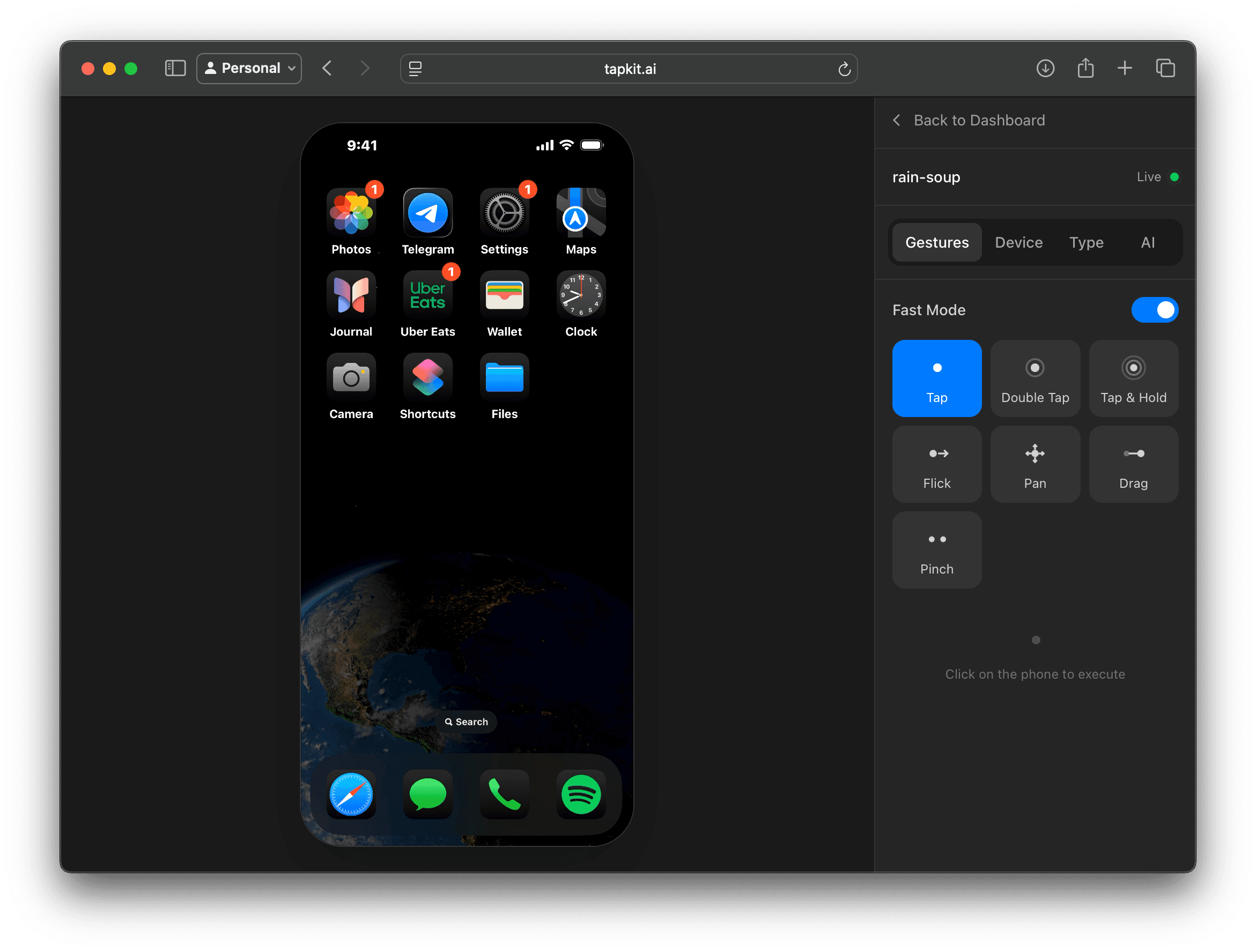
TapKit solves a different problem: giving an AI agent a live iPhone it can inspect and operate as part of a workflow. That is useful when the task depends on the current app state, third-party apps, notifications, accounts, or cross-app behavior.
The two approaches can coexist. Device farms help prove the app works broadly. TapKit helps agents complete and verify real mobile workflows.
Feature comparison
| Criteria | TapKit | Device farms |
|---|---|---|
| Hosted device matrix | Partial | Yes |
| Your own physical iPhone | Yes | Partial |
| Built for AI agent loops | Yes | Partial |
| Run existing Appium/XCUITest/Espresso suites | Partial | Yes |
| Operate arbitrary installed apps/accounts | Yes | Partial |
| Live session monitoring and interruption | Yes | Partial |
| Cross-app operational workflows | Yes | Partial |
| Broad compatibility testing | Partial | Yes |
Device farm fit
If you need to test many OS versions, hardware configurations, screen sizes, and device models, device farms are designed for that.
Teams already invested in Appium, XCUITest, Espresso, and CI pipelines can use device farms to run those suites at scale.
Device farms reduce the need to buy, store, charge, and maintain a large fleet of phones for compatibility testing.
Uploaded app builds, automated test plans, screenshots, videos, logs, and pass/fail reports are device-farm strengths.
TapKit fit
Keep exploring
More ways to give agents a real mobile surface.